MMI 113 MICROBE ASSIGNMENT 
TOXOPLASMOSIS gondii
MARY ADEOSUN

Classification:

Toxoplasma gondii is a single-celled parasite that causes an infectious disease known as Toxoplasmosis. Toxoplasma gondii can be contracted through raw meat, undercooked meat, fecal matter of cats, soil, or by birth (from an infected mother). Symptoms are very rare in humans and animals, but the body develops cysts as the parasite fights. It can cause serious neurological or visual effects in immunocompromised individuals or developing babies. Globally, the parasite responsible for toxoplasmosis i.e.  Toxoplasma gondii has been shown to infect as many as one in three individuals.

BIOLOGY OF TOXOPLASMOSIS:

Toxoplasma gondii is a microscopic organism that can infect people, birds, and mammals. It can go latent (hidden or dormant) in many kinds of organs, and its ability to survive depends on structures like oocytes. Amazingly, these latent infections can remain dormant for an entire lifetime without posing any threat. Once infected, just a small percentage of parasites may stay trapped in cysts in the brain, lungs, and muscular tissue, among other organs. These dormant infections can reactivate in immunocompromised people and last a lifetime.

TRANSMISSION:

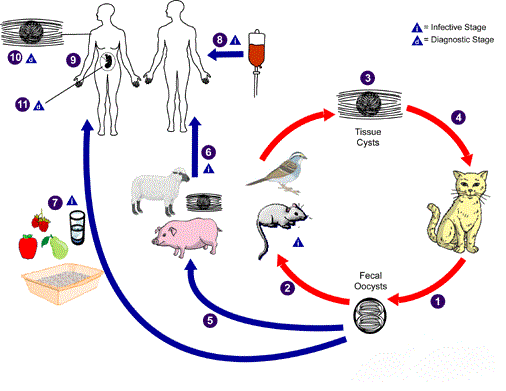
The parasite's infectious form, known as the cysts, is excreted in the fecal matter of infected cats. Oocysts can reproduce and spread disease once they are released into the environment. Oocysts can infect humans directly or indirectly through contaminated food, drink, or soil. oocysts once ingested undergo a rapid transformation into tachyzoites, which establish themselves in muscle and neural tissue, eventually developing into tissue cyst bradyzoites. Toxoplasmosis can be transmitted through cat feces, contaminated food or drink, or undercooked meat. Pregnant women should avoid cat feces to prevent birth-related health complications such as impaired vision, blindness, delayed development, and impaired learning for the unborn fetus., and donors must be screened to prevent transmission through organ transplantation or blood transfusion.

ORGANISIM CAN BE CLASSIFIED AS:

Kingdom: Protozoa

Phylum: Acomplexa

Genus: Toxoplasma

class: Conoidasida

SITE OF INFECTION:

When Toxoplasma gondii infects a person, it can penetrate various tissues, including the liver, spleen, and lymph nodes. While some may experience flu-like symptoms, others may be asymptomatic.

Following an initial infection, a parasite can form cysts in various bodily organs, such as the brain, muscles, and eyes. If the immune system is functioning properly, these cysts can remain inactive and asymptomatic.

Toxoplasma gondii infects tissues, forms cysts in organs, and may cause flu-like symptoms or be asymptomatic. Immunocompromised individuals are at higher risk, and pregnant women may transmit the parasite to the fetus. Ocular toxoplasmosis can cause vision loss if untreated.

SYMPTOMS

Flu-like symptoms, such as fever, headache, muscle aches, skin rash, sore throat, blurred vision in cases of ocular toxoplasmosis etc.

DIAGNOSES

  • Your healthcare professional will speak with you about your symptoms first and do a physical examination to check for toxoplasmosis. The doctor will ask to carry out blood tests and biopsies, they can also request, imaging (MRI or CT scan), amniocentesis (Amniocentesis is a prenatal test that screens for genetic abnormalities by drawing amniotic fluid from the uterus), or ultrasound if you're pregnant.

  • Serologic Testing

  • To determine the duration of an infection, an avidity test can be conducted. This test holds great significance for expectant mothers.

  •  Ocular Disease Diagnosis

TREATMENTS AND PREVENTION

•       Toxoplasma infection is a lifelong condition, and so far, there's no drug that can eliminate the parasite from the body. Medications used to treat toxoplasmosis target the parasite's tachyzoite stage, and pyrimethamine is believed to be the most effective medication. Antibiotics like sulfadiazine are also commonly used with pyrimethamine.

•       Pregnant women should try to avoid changing cat feces as much as possible, and if they must, wear gloves to prevent toxoplasmosis. Expectant mothers should avoid consuming raw meats, ensuring they are cooked to a temperature of 66°C, and thoroughly cleanse fruits and vegetables before consumption to prevent toxoplasmosis.

FUN FACT:

  • An estimated one-third of the global population is thought to be infected with the parasite, which has been discovered in over 60 million people in the United States.

  • Toxoplasmosis gondii is an intestinal parasite with a broad spectrum of intermediate hosts that parasitizes cats and other members of the feline family as definitive hosts.

  • A person with compromised immunity may get serious lung or brain damage because of toxoplasmosis.

  • In the US, foodborne illnesses like toxoplasmosis are thought to be the main cause of death.

  • Toxoplasmosis gondii belongs to the apicomplexan group.

  • Humans and other animals can serve as the intermediate host while the cat is the definite host.

REFERENCE

Centers of Disease Control and Prevention “parasites – toxoplasmosis infection” Accessed October 26, 2023. https://www.cdc.gov/dpdx/toxoplasmosis/index.html 

Journal of the Pediatric Infectious Diseases Society, Volume 3, Issue suppl_1, September 2014, Pages S30–S35, Accessed October 26, 2023 https://doi.org/10.1093/jpids/piu077

Erica dos Santos Martins Duarte. (2022). Toxoplasma Gondii: Prevalence and Role in Health and Disease. Nova Medicine and Health.